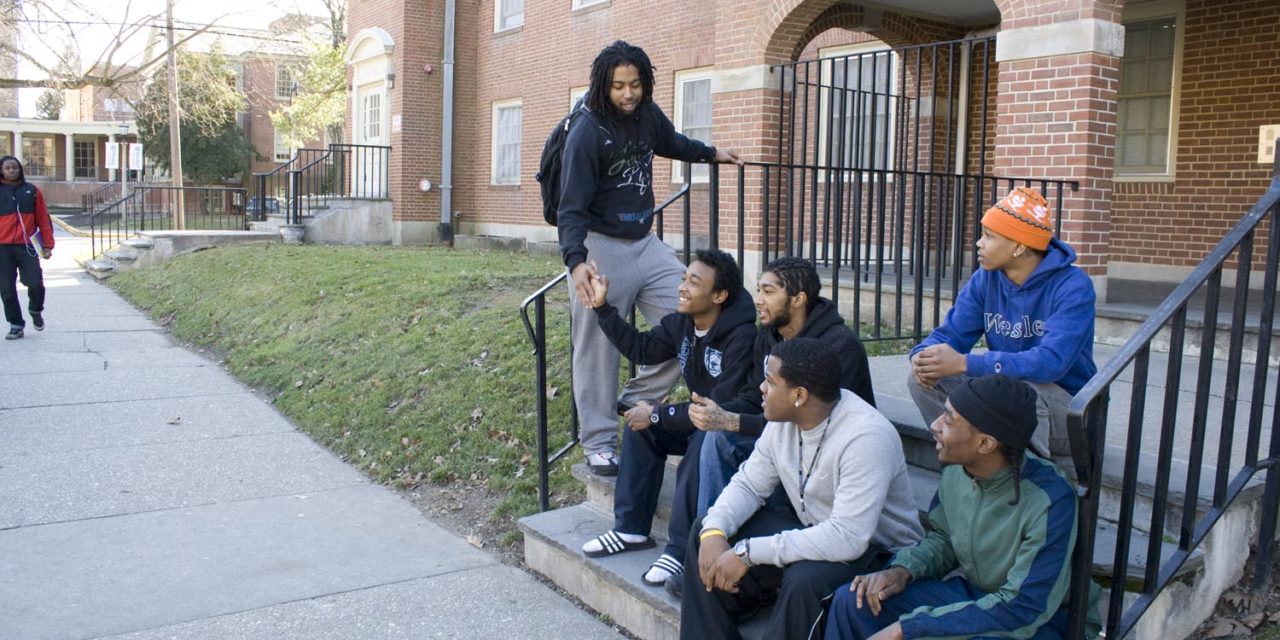

Students sit in front of Williams Hall photo by: Cochise Lucas
By Kimberly Juhas  (Whetstone Contributor)
Many students at Wesley College said they believe there is a kind of segregation going on campus.
But it’s not in class or in the lunchroom. It’s not even in the College Center lobby.
It’s in the residence halls.
Williams, Roe and Gooding halls on the north side of campus are often considered “poorer†than Malmberg, Zimmerman and Carpenter halls further south.
“I would agree that Williams, Roe, and Gooding halls do have a rather unattractive meaning associated with each residence hall as being ‘the ghetto side,’†said Mike Streeter, a residential assistant in Williams.
But Streeter said that the segregation isn’t racial; it’s based on money.
“If anything should be debated about the north side of campus, it is not the issue of race, but economic privilege,†he said.
Williams Hall resident Tyrus Winstead agreed.
“I think that it’s not about race because around campus we all look at each other the same,†he said.
School officials said there are a number of reasons why the campus is divided the way it is.
“Other factors also play a role,†said Kevin Hansbury, director of residence life, “such as college acceptance date, when students confirm their attendance at Wesley, or admissions deposit date.â€
Dean of Students Mary Alice Ozechoski said she was aware of the situation.
“We are looking into possible updates in Williams, Roe and Gooding,†she said, but would not elaborate.
Student Government President Tanner Polce and SGA vice president Bryan Zarou said they do not consider the north side of campus the “ghetto side†or the south part the “suburb side.â€
“You do notice a difference from the two sides based on who lives there, not what color their skin is,†Zarou said.
Williams, Roe and Gooding halls are historically considered freshman dorms.
Polce and Zarou said that new students live in these buildings because there is more of a social feel there, unlike Malmberg and Zimmerman, where you do not see people interact with each other because there is nowhere to interact.
Zarou also said the north side was the area of campus where most of freshmen live.
“Coming into a new place and being intimidated by older students does not happen on that side of campus because they all have an equal playing field,†he said.
Streeter said that despite the perceived differences between the two sides of campus, what is often overlooked is the diversity that makes up Wesley’s campus.