
By Tristin Burris (Whetstone staff writer)
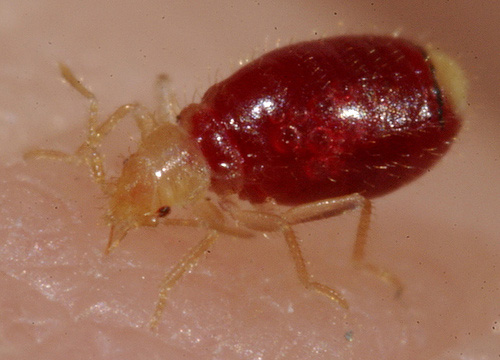
A bed bug on someone's skin.
Last year when Tori Dunbar was a freshman, the Malmberg room in which she and her three roommates lived was infested with bedbugs.
She called maintenance.
“First, they inspected the room and told us who in the room actually had bed bugs,†Dunbar said.
It was one of her roommates.
The college asked her and her roommates to wipe down every bed frame with a bleach solution, pull the furniture away from the walls.
“It took forever,†she said. “We were told if we didn’t do everything on the list that was given to us then the bugs might come back – so we did everything.â€
It wasn’t enough. They came back.
Like hotel rooms, college dorms are one of the most common places to find bedbugs, and Wesley College is no exception. There already have been four confirmed cases of bedbugs affecting students so far this semester, and they have all been in the same dormitory: Malmberg.
College officials said there are one to two cases of bedbugs per semester. Last year alone, there were about six instances. The number is large enough to cause concern among some students, especially since this year’s number is already close to last year’s.
Bedbugs are parasites that feed on a host, typically a human. They are reddish brown, oval shaped and flat. They are about the size of an apple seed.
Kevin Hansbury, serving his fourth year as director of residence life, said that rumors have been spreading throughout the campus and he would like to set the record straight.
“It is an epidemic on college campuses nationally, but not on this campus,†he said. “Wesley has been very fortunate.â€
However, each confirmed case is extremely stressful for the students involved and their families, he said.
Dunbar said after the first cleaning, the bedbugs came back after they returned from Christmas break. They had to clean all over again.
“After the second extermination, we thought we were OK until the end of the year, but apparently, we still had them,†she said. “We kept getting allergic reactions (hives) all over, which the bugs can give off just by being near them, and now the room has them again this year.â€
Although Dunbar was never bitten by the bugs, she says she is thankful they switched rooms this year.
Hansbury said it was unusual for the bugs to return.
“Once a case is confirmed, typically one treatment is enough, but very rarely it will require two treatments,†Hansbury said.
This semester, three of the four cases in Malmberg were successfully tackled with one treatment, he said, and the bugs were cleared. For the fourth case, however, one treatment didn’t work, so special arrangements have been made to have the room sprayed again.
It’s Dunbar’s old room.
“That room still has bugs,†she said. “I heard that room was exterminated again, at least once since school started, but even after the girls went back in, they found live bugs crawling around. I know one of the girls who moved in after us, and she said her and her roommates had to leave it was so bad.â€
Amanda Kinkade, serving her fourth year as resident director in Zimmerman Hall, said “It’s important to note that there have not been complaints of bedbugs every semester.â€
Hansbury said the bugs typically live in mattresses, bed frames, furniture, electrical outlets, and even hide in electronics, which is why everything needs to be cleaned thoroughly.
“Our facilities department does follow up on all cases to make sure the problem is alleviated,†he said. “We try our best to offer students alternative room arrangements either temporarily or permanently. We don’t want them to be uncomfortable.â€
Hansbury said if students suspect a problem, they should call residence life and the facilities department will immediately inspect and make an informed decision.
Students may also go to the health center, located on the ground floor of Carpenter Hall, if they have any bites they want checked out.