
Fall Enrollment by gender and ethnicity
Brittany Wilson, The Whetstone
Walking through College Center, many students can’t help but notice the two poster-sized lists hanging on the wall across from Starbucks.
One, the Dean’s List, includes hundreds of names. The other, the President’s List, honoring those who maintain a straight-A, 4.0 GPA, displays only 64.
After a glance, one thing about the President’s List becomes plain: most of the students on the President’s list are women. Upon further analysis, it was found that most are white, nearly half are nursing majors and more than half come from Delaware.
Brooke Thompson, a junior on the President’s List, said she has never heard students talk much about it.
“It’s definitely not something you hear people say they are striving for,†she said. “If anything I hear someone say something like, ‘Oh hey, I made the Dean’s list,’ but I don’t think many people even think about the President’s list.â€
According to an article from the New York Times, Department of Education statistics show that women are not only more likely to get their bachelor’s degree, but are also are more likely to achieve better grades in college than men.
Wesley College is no exception.
Of the 64 students listed on the President’s List, 47 are female—more than 73 percent.
Thompson said she was not surprised when she found out women make up about three-fourths of the list.
“I was always under the impression that lately women have been academically superior to men,†she said. “The numbers are not quite as shocking because they correlate with what I’ve been hearing lately.â€
About 20 different majors are represented by the students on the list. Still, of the 64 students, nearly half are nursing majors. The psychology department is the second-most represented on the list, about 5 percent.
Dr. Robert Contino, professor of nursing and chair of the nursing department, said he was excited to see so many of his students on the list.
“We do have higher admission standards than the rest of the college,†he said. “In nursing, we have to do this to be sure that we are attracting good students academically. Not only are they responsible for caring for people once they graduate, but they have to pass a licensing exam.â€
Contino said nursing majors are dedicated students.
“There’s very few, if any, other majors on campus that require their students to get up at 5 a.m., leave the dorm at 5:30, drive an hour to their clinical, and get home at 3 or 4 o’clock in the afternoon,†he said.
Thompson, who majors in environmental science, said she thinks nursing majors make up about 42 percent of the list because they are required to keep good grades to remain in the program.
“Nursing majors will be in situations where they could potentially be saving lives, whereas someone like me in environmental science, or someone in math or sports management will not be encountering such serious situations,†she said.
More than 56 percent of the students on the President’s list are from Delaware. The other states most widely represented on the list include New Jersey (15.6 percent), Maryland (9.4 percent), Pennsylvania (7.8 percent), and New York (4.7 percent).
Interim Vice President for Academic Affairs Dr. Jeffrey Gibson said the most intriguing part of the regional statistics is their correlation to the honors program.
“One thing we have been trying to do is recruit more students from the state of Delaware than what we did in the past,†he said. “We’ve seen a large increase in the number of our honors students over the past four or five years. A healthy number of those students are from Delaware, who, for one reason or another, did not want to go out of state. They are quality students.â€
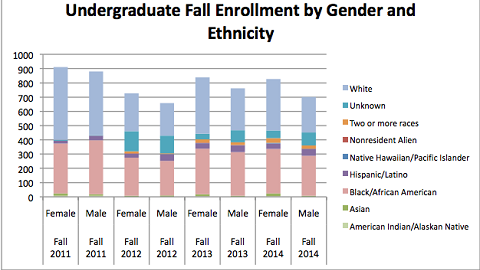
According to trends in undergraduate enrollment, from 2011-2014 there were about the same number of white and African American students at Wesley. In fall 2014, 594 African American students and 610 white students were enrolled as undergrads—about 79 percent of the student body. Students of other races, such as Asians and Hispanics accounted for the rest.
Of the 64 students on the President’s list, 45 (70 percent) are white. The remaining 30 percent is composed of 12.5 percent African American, 7.8 percent Hispanic, 4.7 percent Asian, and 4.7 percent multi-racial students or students of unknown race.
Assuming enrollment numbers have maintained the same trends, about 11.5 (3 of 26) percent of the Asian population on campus is represented on the President’s List, followed by 7.4 percent (45 of 610) of white students and about 6 percent of Hispanic students (5 of 86). Only 1.3 percent (8 of 594) of Wesley’s African American students is listed.
Thompson said she was more surprised by the racial disparity of the list than any of the other statistics.
“I am shocked that the numbers are not even close,†she said, referring to the list’s 57.5 percent difference in representation between white students and African American students.
Gibson said these numbers do not imply that the categories with fewer people in them are not equally capable.
Nick McDaniels, a junior on the President’s list, said success has more to do with a student’s effort and attitude than their gender, ethnicity, or major.
“If more people were open to pursuing new goals rather than just being satisfied with average, at that point is when I think ‘Great Things Await’ for the Wesley community,†he said. “At that point I think the diversity of the Presidents List would increase tremendously.â€